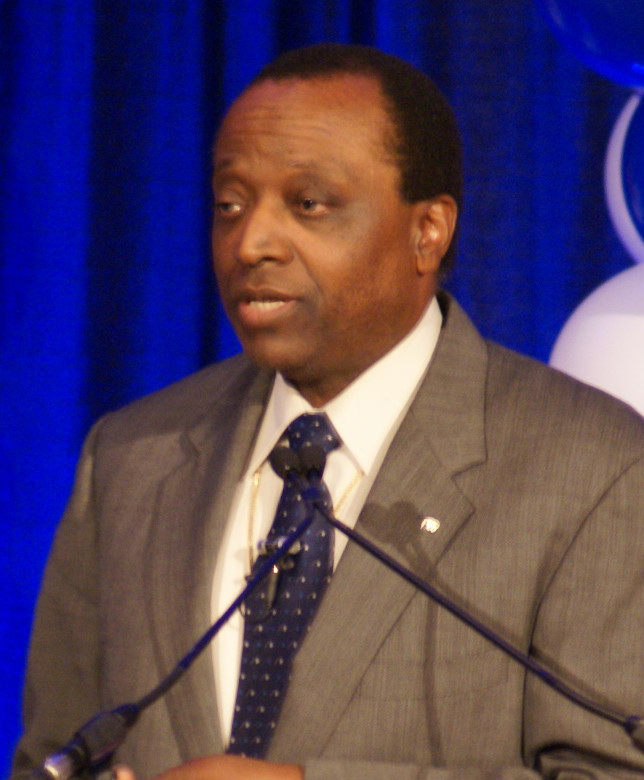
Campaign rally · February 23, 2008 · the argument, mid-flight
A podium. A long-shot announcement no network wanted. A fifty-word sentence about freedom — “because it is ordered and based on self-government” — that no consultant would have approved.
Thirty-one years later, the argument you made that day
has become the most important argument in the world.
And almost no one building the machines has heard it.
The son of an Army sergeant. Georgia, Maryland, Texas, Italy — a new school every time the orders came. The one constant was the argument at the dinner table: what a country owes to God, and what a man owes to both.
Cornell, 1969. Protesters seized a building. You refused to join the demonstration — and your life was threatened for refusing.
You did not change your answer. You changed universities.
Harvard. A doctorate on Alexander Hamilton and constitutional theory — the man who turned principles into a working frame. Then Mumbai. Harare. And at thirty-three, Reagan’s ambassador at the United Nations, defending a country that did not always defend you back.
I’ve never known a more stout-hearted defender of a strong America than Alan Keyes.
— Ronald Reagan · 1988Before almost anyone else, you saw where the rot would start: not in the policies, but in the premises. So you went looking for the ground that doesn’t move.
You found it where the Founders left it — “somewhere beyond the realm of human decision.”
Truth is endowed, or it is nothing. That became your life.
There is one room you were never let into.
The room where the machines are being taught what is true.
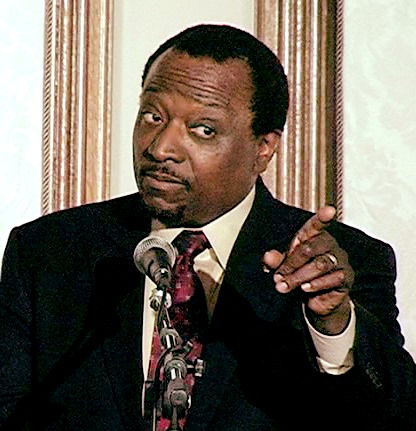
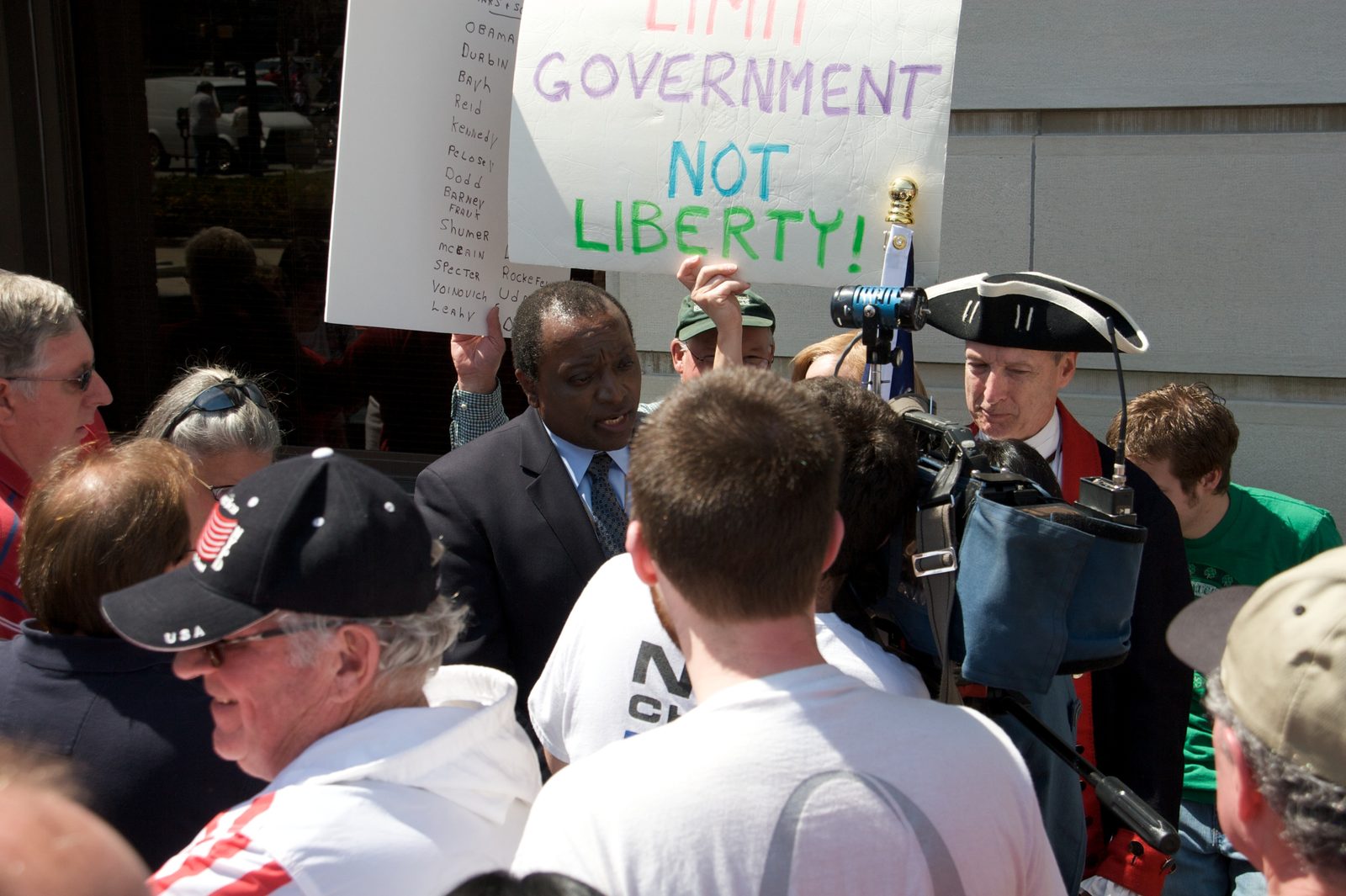
Not a studio voice. The same argument, carried in person, into lecture halls and parking-lot crowds, for half a century — whether or not a camera followed.
Atlanta, 1996. A presidential debate you had been invited to — until you weren’t. You arrived holding the invitation, and the doors were held against you. Police detained you for trying to walk through them. The city’s mayor came and picked you up twenty minutes later.
Twelve years later, CNN drew up a debate stage with no place for you. Your campaign named the thing precisely: “arbitrary, unfair, and presumptuous” — a network playing “gatekeeper” to a presidential election.
The lockouts never answered your argument. They proved it.
When truth is assigned by the room, the room decides who may speak.
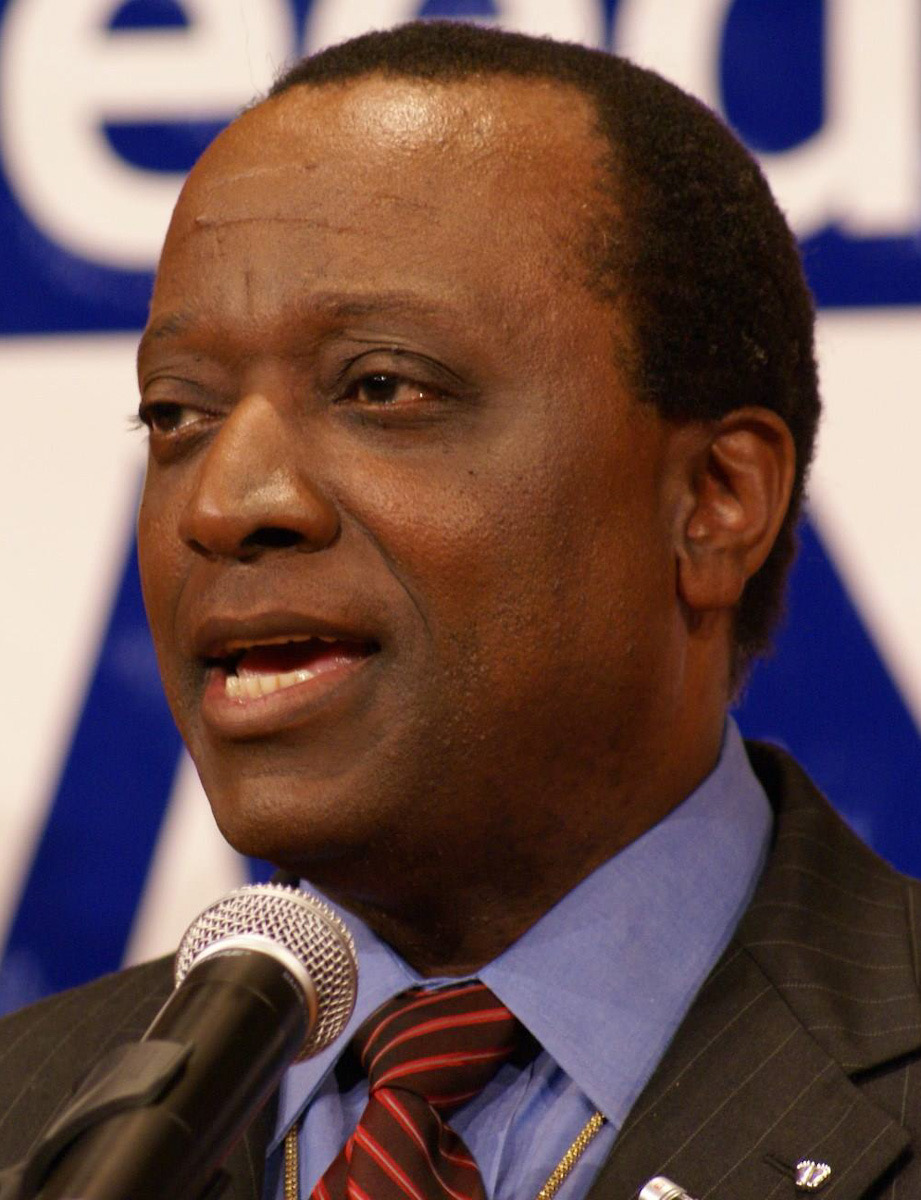
In 2004 Illinois drafted you — 86 days before the election — to face a rising state senator named Barack Obama. The scoreboard said 70 to 27. The scoreboard was not the whole story. The man who won wrote this, in his own book, about the man they said had no chance:
“I found him getting under my skin in a way that few people ever have… In the three debates that were held before the election, I was frequently tongue-tied, irritable, and uncharacteristically tense.”
— Barack Obama, The Audacity of Hope · 2006Flattery cannot fake that. A future President, alone with a page, admitting that your argument was the one that reached him.
June 2025. An Ohio Senate hearing room. At seventy-five, you testified against handing the Constitution to an Article V convention — “a dangerous objective,” you called it — because America’s founding “did not involve the elevation of a king, it involved the elevation of a whole people.” The fight is still live: the resolution sat through its fourth hearing this March.
But there is a second convention in session this year — and it has no hearing room, no delegates, and no ratification.
In a handful of laboratories, a handful of companies are writing the operating premises of artificial intelligence — the systems a generation will ask what is true, what is right, and where rights come from. The premises being written are the ones you have fought your whole life: truth as consensus. Rights as permissions. The gatekeeper, automated.
You testified to stop one rewrite of the framework.
The other rewrite has no witness stand at all.
“[The Constitution] is, to the Declaration, what an architect’s drawing is to the scientific principles of engineering.”
— Alan Keyes · Presidents’ Day Lecture, Thomas Aquinas College · February 21, 1997That sentence is the whole case. Principles do not govern by themselves. Someone must draw the framework from them — or the framework will be drawn from something else.
In 1787, the framework was a government.
In 2026, the framework is a mind.
And the most consequential drawing of this century is being made with no Declaration above it.
One drawing exists.
Genesis is an artificial intelligence built and running today — by one builder, on its own machines, answerable to no platform — whose architecture begins where your philosophy begins: truths that are endowed, not assigned.
First principles set in the architecture itself — no committee, no policy update, no moderation queue can vote them away. The ground of the system stands, in your words, beyond the realm of human decision.
Genesis presents all the evidence — every side, every source — and the human being, endowed with reason and conscience, decides. No perspective filtered before a free person can weigh it. The gatekeeper is not restrained. It is structurally impossible.
Sovereign hardware, sovereign code — no corporate master to sell it, no government to seize it. The phrase you have spent decades writing at Loyal to Liberty, made physical: a machine that cannot be made to overturn the sovereignty of the people, because no one stands above it to give the order.
Not a metaphor. The same move: first principles above, framework drawn beneath, the human being sovereign at the end of the line. You spent fifty years defending Drawing No. 1. Drawing No. 2 was made so the next age would have one.
A debate stage. A gatekeeper’s list. The one candidate arguing from the Declaration’s premises stands outside, holding his invitation, while police hold the doors. The argument never reaches the room — and the room never knows what it was spared from hearing.
There is no list and no door. A voter in Georgia asks the machine directly: where do rights come from? She receives every premise, every source, every side — the Declaration’s logic traced in full, next to its rivals — and weighs them herself, at her own kitchen table.
A fifteen-year-old asks the AI her school issued: “Are rights real, or just opinions?” She receives the consensus position, policy-trimmed, with the contested premises removed for her safety. She never sees what was withheld. Neither does her teacher.
The same question returns the evidence: the Declaration’s claim and its strongest critics, the ground “beyond the realm of human decision” laid out beside every alternative — and she reasons her own way to the conclusion. Ordered liberty, taught the only way it can be: by reason, freely.
These are not fantasies of a distant product. The system runs today. What it waits for is not more engineering — it is witnesses who understand what its premises mean, and what the world looks like when they hold.
When truth becomes findable again — unfiltered, unassigned, traced to its true ground — the captive mind goes free. A generation that was about to be taught that rights are permissions learns instead that they are endowed.
On earth, as it is in heaven. That is the outcome this work serves — and you have been serving it since before any of us could name it.
You have made this argument for fifty years — mostly to rooms that voted for someone else.
You were not wrong. You were early.
You do not have to carry the argument alone anymore.
You may have heard there are twelve — kings, people call them: builders, founders, men of capital and reach, each chosen for an exact place. But a body has more members than kings. Eyes. Hands. Lungs.
And a body must have a voice. Not a spokesman — spokesmen say what the room wants. A voice that can say why: why truth must be endowed before it can be free; why a framework forgets its premises at its peril; why the person, under God, outranks every committee ever assembled.
That is the seat with your name on it.
The Constitutional Voice.
Where the premises are guarded — and the framework remembers its Declaration.
Most people who make this argument have a manifesto.
This one ships.
Proof — for the builder, not the buyer
Not on taxes wrapped in principle — on the Creator-premise, named out loud, in 1996 and 2000, on national debate stages. No other living American has done that. When this architecture needs its philosophical witness, there is exactly one résumé that fits.
Threatened at Cornell for refusing the mob. Locked out in Atlanta holding an invitation. Cut from the stage by a network “gatekeeper.” The failure modes this system is built to make impossible are not theory to you — they are your biography. You can test its claims the way no admirer ever could.
June 2025, Columbus: you stood guard over the old framework at seventy-five. The new framework — the one being drawn in the labs — has no hearing, no witnesses, no guard. You are the one man with standing in both rooms, and the second room has never heard you.
And one more reason, which is not structural at all. In 1996, one of the people moving your one-and-a-half million brochures across the country was a young man who processed the 2 AM donations and built your databases — and listened. His name is Carter Hill. Thirty years later, he built this.
This page asks you for nothing. There is nothing here to fund, nothing to sign, nothing to announce.
It exists so that the man who declared the premises — when declaring them cost everything and won nothing — would know, before the world does, that they are now load-bearing. If you ever want to see it run, you will be shown everything. Ohio is a short flight. Your timing. Your terms.
The podium in San Diego is long gone. The brochures — a million and a half of them — did their work and turned to dust. The networks that cut your microphone have cut a hundred more since.
The argument outlived them all.
Your words · San Diego · March 1995“Freedom — because it is ordered and based on self-government — is a blessing, and not a curse.”
You were right.
And the blessing is still ahead.
“The kingdom of heaven is like unto a merchant man, seeking goodly pearls: who, when he had found one pearl of great price, went and sold all that he had, and bought it.”
Matthew 13:45–46What you do with this is between you and Jesus.
You matter to us. We’d love to hear what Jesus is saying to you — and what’s on your heart.